Facts about Austria: Geography, Capital and Key Information
Introduction
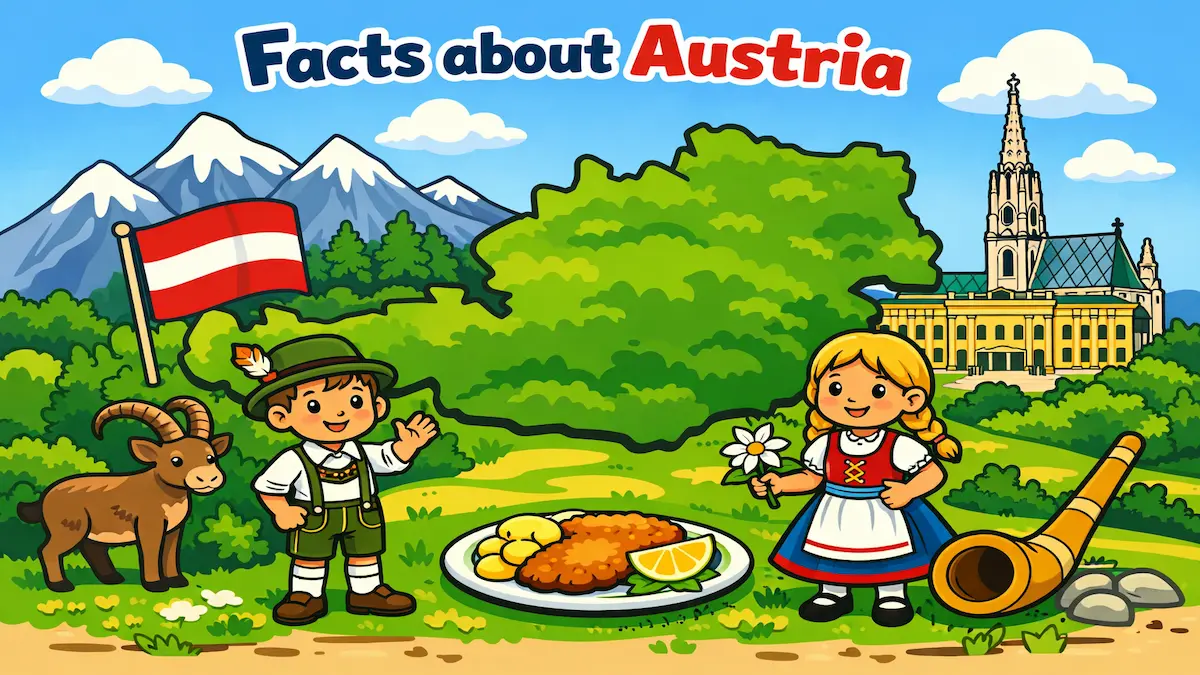
Austria is a beautiful country located in the heart of Europe, known for its dramatic Alpine landscapes, historic cities, and rich cultural traditions. From snow-covered mountains to elegant classical music halls, the country offers a fascinating mix of nature and history. Vienna, its capital city, has long been a center for art, music, and architecture. Learning facts about Austria helps us understand why this small country has had such a large cultural influence across Europe. In this article, we explore geography, culture, and some interesting facts about Austria.
Quick Facts about Austria
- Capital city: Vienna
- Population (approx.): Around 9,000,000 people
- Area (km²): 83,879 km²
- Currency: Euro (€)
- Official language(s): German
- National Day: 26 October
Geography and Landscape
Austria is a landlocked country in Central Europe, meaning it has no coastline. One of its most defining geographical features is the Alps mountain range, which covers a large portion of the country. These mountains shape the landscape and play an important role in the climate, environment, and economy of Austria.
The western and southern regions of the country are dominated by high Alpine peaks, deep valleys, and clear mountain lakes. These areas are popular destinations for skiing in winter and hiking in summer. Some of the most famous Alpine regions include Tyrol and Salzburg, where dramatic mountain scenery attracts visitors from all over the world.
Eastern Austria looks quite different from the mountainous west. The land becomes flatter and more open, with rolling hills and fertile plains. This region includes the Danube River valley, one of the most important waterways in Europe. The Danube flows through the country from west to east and passes directly through Vienna, Austria’s capital.
Austria also contains many forests, rivers, and lakes that support a wide range of wildlife. National parks help protect natural habitats and allow people to experience the country’s landscapes responsibly. The combination of mountains, rivers, forests, and valleys makes Austria one of the most geographically diverse countries in Europe.
Population and Culture
Austria has a population of around 9,000,000 people, with most living in cities and towns across the eastern and central parts of the country. Vienna is by far the largest city and serves as the political, economic, and cultural center of the nation.
German is the official language spoken throughout Austria, although the Austrian version includes its own accents and regional expressions. In some regions, especially near the borders, minority languages and dialects are also spoken.
Austria is famous for its contributions to music, art, and culture. The country played a major role in the development of classical music, producing some of the most celebrated composers in history, including Wolfgang Amadeus Mozart, Franz Schubert, and Johann Strauss II. Vienna in particular became known as the “City of Music” because of its long tradition of orchestras, opera houses, and musical innovation.
Cultural traditions remain an important part of everyday life. Festivals, folk costumes, and regional foods reflect Austria’s history and its Alpine heritage. Dishes such as Wiener Schnitzel and apple strudel are well known both inside and outside the country.
Austria also places great importance on education, arts, and preservation of historical sites. Visitors can explore medieval towns, grand imperial palaces, and centuries-old churches that tell the story of Austria’s past.
3 Interesting Facts about Austria
-
Austria was once the center of a powerful empire.
The Austro-Hungarian Empire ruled large parts of Central and Eastern Europe before the early 20th century. -
Vienna is one of the most livable cities in the world.
The capital has repeatedly been ranked highly due to its quality of life, public transportation, and cultural offerings. -
The Alps cover around two-thirds of Austria’s land area.
This makes Austria one of Europe’s most mountainous nations.
Where is Austria Located?
Austria is located in Central Europe and shares borders with eight different countries. To the north, it borders Germany and the Czech Republic. To the east, it borders Slovakia and Hungary. In the south, Austria meets Slovenia and Italy, while Switzerland and Liechtenstein lie to the west.
Because of its central position, Austria has historically served as an important crossroads between Western and Eastern Europe. Trade routes, cultural exchanges, and political connections have passed through the region for centuries.
The country’s location also contributes to its diverse landscapes. The western regions connect to the high Alpine ranges shared with Switzerland and Italy, while the eastern plains link Austria to the wider Danube basin and the lowlands of Hungary and Slovakia.
This central location has helped shape Austria’s cultural identity. Influences from neighboring countries can be seen in architecture, cuisine, and traditions. At the same time, Austria has maintained a distinct national culture rooted in its history and Alpine environment.
Discover More About European Countries
Europe is a continent filled with diverse landscapes, cultures, and histories. Learning about different countries helps students and curious readers better understand how geography, traditions, and people shape each nation. Austria is just one of many fascinating countries to explore.
Our books provide clear and engaging introductions to the countries of Europe, making them ideal for students, teachers, homeschoolers, and geography enthusiasts who want reliable and easy-to-understand information.
-
The European Countries Book – Extended Color Edition
https://www.amazon.com/dp/B0G33G45CJ -
The European Countries Book – Color Edition
https://www.amazon.com/dp/B0FX9C7TS5 -
The European Countries Book – Black & White Edition
https://www.amazon.com/dp/B0FDRXJX7C