Facts about Belgium: Geography, Capital and Key Information
Introduction
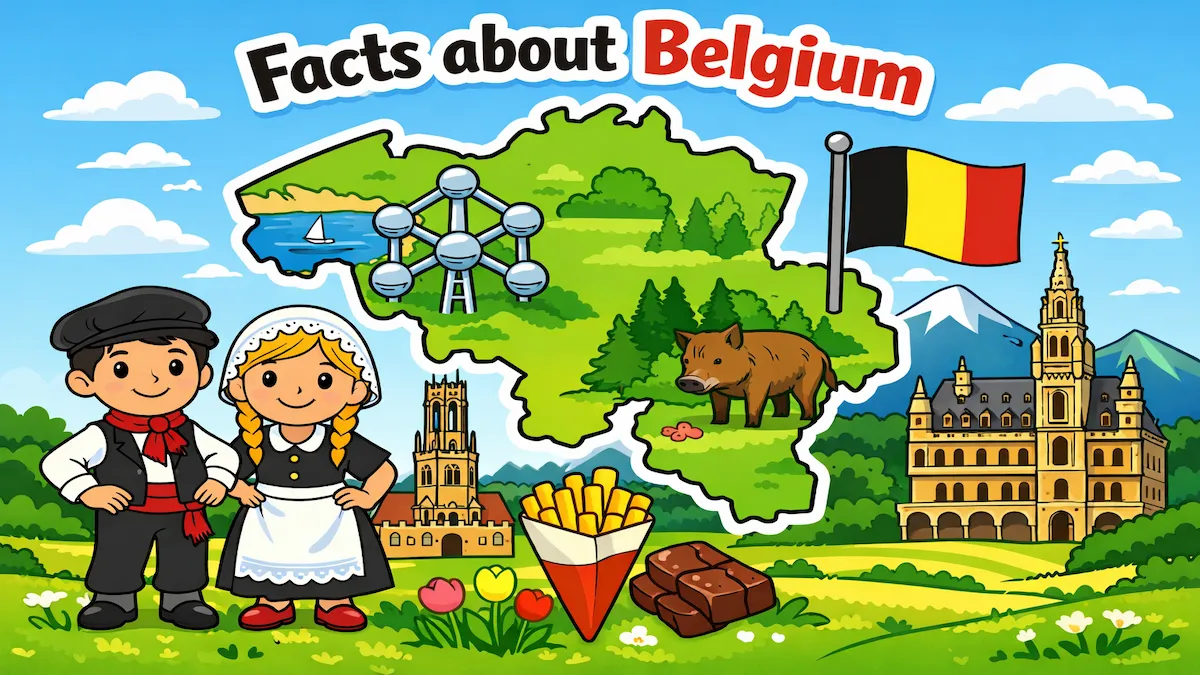
Belgium is a small but important country located in Western Europe. It is known for its rich culture, historic cities, and role in European politics. Facts about Belgium often highlight its unique mix of languages and traditions. Despite its size, Belgium has had a strong influence on history, trade, and international cooperation. It is a fascinating country to study for students and geography enthusiasts alike.
Quick Facts about Belgium
- Capital city: Brussels
- Population (approx.): Around 11,500,000 people
- Area (km²): 30,689 km²
- Currency: Euro (€)
- Official language(s): Dutch, French, German
- National Day: 21 July
Geography and Landscape
Belgium has a varied landscape that can be divided into three main regions. In the northwest, there is a coastal plain along the North Sea. This area is mostly flat and includes sandy beaches, dunes, and polders—land that has been reclaimed from the sea. It is also an important region for tourism and fishing.
Moving inland, the central part of Belgium consists of gently rolling hills and fertile farmland. This region is home to many of the country’s largest cities and towns. The soil here is ideal for agriculture, and crops such as wheat, sugar beets, and vegetables are commonly grown.
In the southeast lies the Ardennes region, which is quite different from the rest of the country. The Ardennes is a hilly and forested area with deep valleys and rivers. It is less densely populated and is known for outdoor activities like hiking and cycling. This region also played an important role during historical events such as World War II.
Belgium has a temperate maritime climate. This means the weather is generally mild, with cool summers and relatively mild winters. Rainfall is spread throughout the year, and cloudy days are common. The climate supports green landscapes and lush vegetation across the country.
Population and Culture
Belgium has a population of around 11.5 million people. One of the most interesting aspects of the country is its linguistic diversity. There are three official languages: Dutch, French, and German.
The northern region, called Flanders, mainly speaks Dutch. The southern region, Wallonia, is primarily French-speaking. In the eastern part of the country, there is a smaller German-speaking community. Brussels, the capital city, is officially bilingual, with both French and Dutch widely used.
Belgium’s culture reflects this diversity. Traditions, food, and even architecture can vary between regions. However, there are also many shared cultural elements. Belgium is famous for its chocolate, waffles, and fries. Belgian chocolate is considered some of the best in the world, and waffles are enjoyed both as street food and desserts.
The country is also known for its festivals, art, and historic buildings. Medieval towns, castles, and grand squares can be found throughout Belgium. Brussels is especially important internationally, as it hosts key institutions of the European Union, making it a center for diplomacy and cooperation.
3 Interesting Facts about Belgium
-
Belgium has three official languages
Dutch, French, and German make it one of the most linguistically diverse countries in Europe. -
Brussels is often called the “capital of Europe”
Many European Union institutions are based there. -
Belgium is famous for chocolate, waffles, and fries
They are an important part of its culture and known worldwide.
Where is Belgium Located?
Belgium is located in Western Europe and is bordered by several countries. To the south and southwest, it shares a border with France. To the east, it borders Germany, and to the southeast, it borders Luxembourg. The Netherlands lies to the north.
Belgium also has a coastline along the North Sea in the northwest. This coastal access has been important for trade and transportation throughout history.
Because of its central location in Europe, Belgium has often been a crossroads for travel, trade, and cultural exchange. Its position has also made it historically significant, as many important events have taken place in or near its territory.
Discover More About European Countries
Learning about countries like Belgium helps build a deeper understanding of Europe’s geography, cultures, and political systems. Clear maps, structured facts, and concise explanations make it easier for students, parents, and teachers to explore each country step by step.
If you want a comprehensive and accessible overview of all European countries, our books provide detailed maps, key facts, and essential information in a structured format that supports both learning and curiosity.
-
The European Countries Book – Extended Color Edition
https://www.amazon.com/dp/B0G33G45CJ -
The European Countries Book – Color Edition
https://www.amazon.com/dp/B0FX9C7TS5 -
The European Countries Book – Black & White Edition
https://www.amazon.com/dp/B0FDRXJX7C