
Facts about Bosnia and Herzegovina: Geography, Capital and Key Information
Introduction
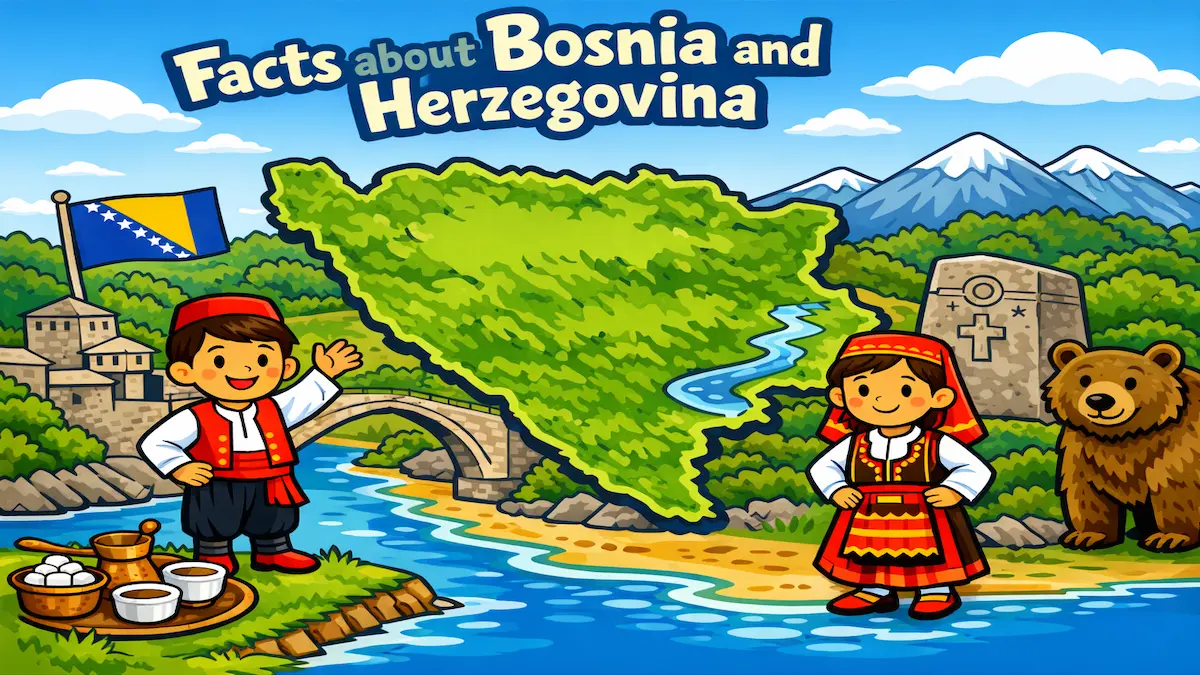
Bosnia and Herzegovina is a country in Southeast Europe known for its mountainous landscapes and rich cultural diversity. It lies in the Balkan region, where different traditions and histories come together. Many people search for facts about Bosnia and Herzegovina to better understand its geography, people, and history. Despite its relatively small size, the country offers a wide range of natural and cultural features. Learning about it helps build a stronger understanding of Europe as a whole.
Quick Facts about Bosnia and Herzegovina
- Capital city: Sarajevo
- Population (approx.): Around 3,200,000 people
- Area (km²): 51,000 km²
- Currency: Convertible Mark (BAM)
- Official language(s): Bosnian, Croatian, Serbian
- National Day: 1 March (Independence Day)
Geography and Landscape
Bosnia and Herzegovina is known for its varied and often rugged landscape. Much of the country is covered by the Dinaric Alps, a mountain range that stretches across the western part of the Balkan Peninsula. These mountains create a landscape of steep hills, deep valleys, and forested areas.
The central and southern regions are especially mountainous, while the northern part of the country has more lowlands and plains. These flatter areas are often used for agriculture and settlement.
Rivers play an important role in shaping the country’s geography. Some of the most important rivers include the Bosna, Drina, and Neretva. The Neretva River is especially well known for its clear water and scenic surroundings. These rivers are not only important for nature but also for transportation and energy.
Bosnia and Herzegovina also has a small coastline along the Adriatic Sea, located near the town of Neum. Although the coastline is short, it provides the country with access to the sea, which is important for trade and tourism.
Forests cover a large part of the country, making it one of the more heavily forested nations in Europe. This contributes to rich biodiversity, including a variety of plant and animal species. Overall, the geography of Bosnia and Herzegovina is diverse and strongly shaped by its mountainous terrain.
Population and Culture
Bosnia and Herzegovina has a population of around 3,200,000 people. The country is known for its cultural diversity, which is reflected in its ethnic groups, languages, and traditions.
The three main ethnic groups are Bosniaks, Croats, and Serbs. Each group has its own cultural traditions, but they also share many aspects of daily life. This diversity is an important part of the country’s identity.
Three official languages are spoken: Bosnian, Croatian, and Serbian. These languages are very similar and are understood by most people across the country.
Religion also plays a role in cultural life. The main religions include Islam, Eastern Orthodox Christianity, and Roman Catholicism. Religious buildings such as mosques, churches, and monasteries can be found throughout the country.
Traditional food is an important part of culture. Common dishes include grilled meats like ćevapi, pastries such as burek, and a variety of soups and bread. Meals are often enjoyed with family and friends, reflecting a strong sense of community.
Festivals, music, and local customs also play a role in everyday life. The capital city, Sarajevo, is especially known for its cultural mix and historical significance.
3 Interesting Facts about Bosnia and Herzegovina
-
One of Europe’s last primeval forests.
Perućica Forest is among the last remaining primeval forests on the continent. -
Sarajevo hosted the 1984 Winter Olympics.
The city became an important location in sports history. -
Three official languages, widely understood.
Bosnian, Croatian, and Serbian are very similar and widely understood by citizens across the country.
Where is Bosnia and Herzegovina Located?
Bosnia and Herzegovina is located in Southeast Europe, in a region known as the Balkans. It is positioned on the Balkan Peninsula, which is an area known for its complex geography and cultural diversity.
The country shares borders with several neighboring nations. To the north, west, and southwest lies Croatia. To the east is Serbia, and to the southeast is Montenegro. These neighboring countries are also part of the Balkan region.
Although it is mostly landlocked, Bosnia and Herzegovina has a small stretch of coastline along the Adriatic Sea. This coastal area is located near the town of Neum and provides the country with limited access to the sea.
Its location makes Bosnia and Herzegovina an important link between Central and Southeast Europe. It also reflects a mix of cultural influences from both eastern and western parts of the continent.
Discover More About European Countries
Learning about Bosnia and Herzegovina is a great way to understand the diversity of Europe. Each country has its own geography, culture, and history, and exploring them helps build a broader perspective of the world.
If you want a comprehensive and accessible overview of all European countries, our books provide detailed maps, key facts, and essential information in a structured format that supports both learning and curiosity.
-
The European Countries Book – Extended Color Edition
https://www.amazon.com/dp/B0G33G45CJ -
The European Countries Book – Color Edition
https://www.amazon.com/dp/B0FX9C7TS5 -
The European Countries Book – Black & White Edition
https://www.amazon.com/dp/B0FDRXJX7C