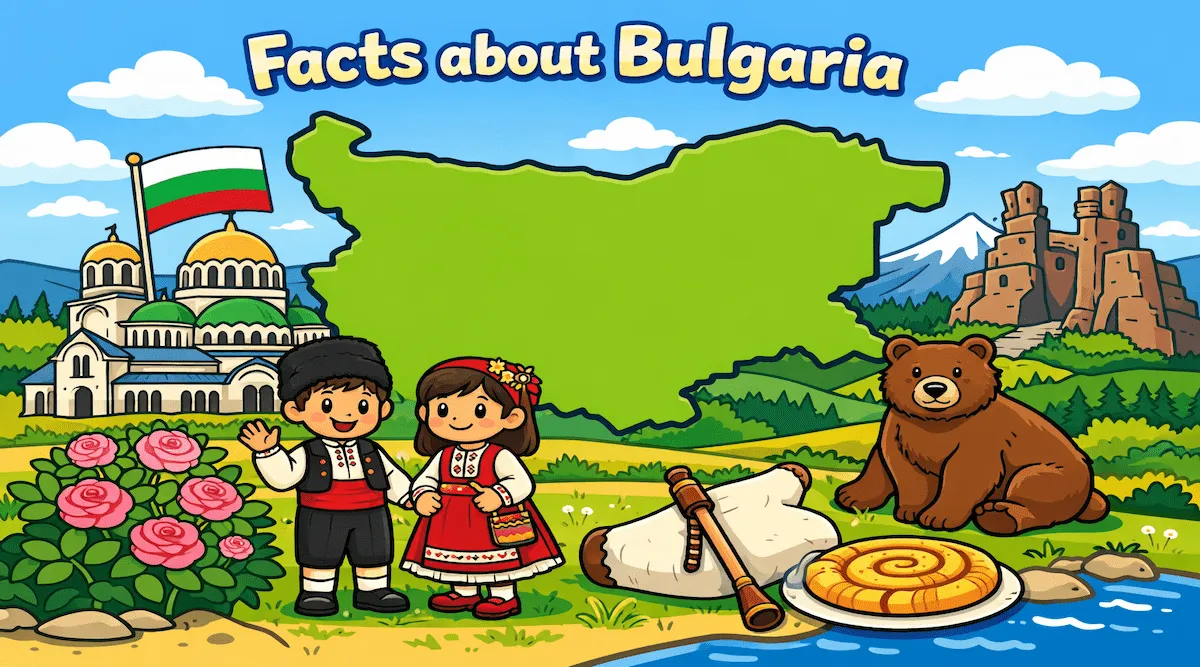
Facts about Bulgaria: Geography, Capital and Key Information
Introduction
Facts about Bulgaria reveal a country where ancient history, dramatic landscapes, and a resilient culture come together in the heart of the Balkans. Situated in Southeastern Europe, Bulgaria is one of the oldest nations on the continent, with roots stretching back to the first Bulgarian Empire in the seventh century. Its territory spans mountain ranges, fertile plains, and a long Black Sea coastline, making it one of Europe’s most geographically varied countries. Whether you are a student, teacher, or geography enthusiast, Bulgaria offers a compelling window into European history and natural diversity.
Quick Facts about Bulgaria
- Capital city: Sofia
- Population (approx.): Around 6,500,000 people
- Area (km²): 110,879 km²
- Currency: Bulgarian Lev (BGN)
- Official language: Bulgarian
- National Day: 3 March
Geography and Landscape
Bulgaria occupies the northeastern part of the Balkan Peninsula in Southeastern Europe. At 110,879 km², the country packs an impressive variety of landscapes into a relatively compact area. The Balkan mountain range — known locally as Stara Planina — runs east to west through the middle of the country, effectively dividing Bulgaria into a northern and a southern zone. This spine of mountains gives Bulgaria much of its dramatic character and has played a decisive role in shaping settlement, trade routes, and military history.
To the south, the Rhodope Mountains form a vast and heavily forested highland region that stretches toward the borders with Greece and North Macedonia. Bulgaria’s highest point, Musala Peak at 2,925 metres, rises in the Rila Mountains — part of the larger chain in the southwest. The Rila range is one of the most striking mountain landscapes in the whole of Europe, home to glacial lakes, dense conifer forests, and protected national park territory.
The Danube River forms Bulgaria’s natural northern border with Romania, flowing westward and draining into the Black Sea further east. The Danubian Plain between the Danube and the Balkan range is fertile and agricultural, producing wheat, sunflowers, and wine grapes. Bulgaria’s wine regions are well established, particularly in the Thracian Valley to the south of the Balkans, where a warm climate and productive soils support viticulture with a long tradition.
Bulgaria’s eastern edge meets the Black Sea, giving the country a coastline of around 378 kilometres. The coast combines sandy beaches popular with summer visitors and quieter rocky stretches, with the ports of Varna and Burgas serving as the main maritime hubs. This coastal access has connected Bulgaria to wider trade networks throughout its history and remains economically significant today.
Population and Culture
Bulgaria has a population of approximately 6.5 million people. Sofia, the capital, is by far the largest city and serves as the country’s political, economic, and cultural center. Other important cities include Plovdiv, the second-largest city and one of the oldest continuously inhabited cities in Europe, as well as Varna and Burgas on the Black Sea coast.
Bulgarian is the official language and is written in the Cyrillic alphabet — a script originally developed in the First Bulgarian Empire during the ninth century by Saints Cyril and Methodius. This is a point of significant national pride, as Bulgaria is the birthplace of the Cyrillic script now used across much of Eastern Europe and Central Asia.
The culture of Bulgaria blends Thracian, Slavic, and Byzantine influences accumulated over more than a millennium. Orthodox Christianity plays a central role in cultural and community life, and Bulgarian Orthodox churches — from the ornate Alexander Nevsky Cathedral in Sofia to ancient rock monasteries in the Rhodopes — are important landmarks across the country. The Rila Monastery, founded in the tenth century, is Bulgaria’s most visited cultural monument and a UNESCO World Heritage Site.
Bulgarian folk traditions are vivid and well preserved. Music featuring asymmetric rhythms and instruments such as the gaida (bagpipe) and kaval (flute) are distinctive features of Bulgarian folk culture. Traditional embroidery, pottery, and the celebration of name days alongside birthdays remain part of everyday life, particularly outside the major cities.
National Day on 3 March commemorates the signing of the Treaty of San Stefano in 1878, which ended the Russo-Turkish War and restored Bulgarian statehood after nearly five centuries of Ottoman rule. The date marks a defining moment in Bulgarian national identity and is observed with ceremonies and reflection across the country.
3 Interesting Facts about Bulgaria
-
Bulgaria is the birthplace of the Cyrillic alphabet. The script was created in the ninth century by the scholars Cyril and Methodius, who worked in the First Bulgarian Empire. Today, Cyrillic is used by hundreds of millions of people across Russia, Ukraine, Serbia, and many other countries.
-
Bulgaria is home to some of the oldest gold artefacts ever discovered. The Varna Necropolis, excavated near the Black Sea coast, contains gold jewellery and objects dated to around 4,500 BCE — among the oldest processed gold in the world, predating the Egyptian pyramids.
-
Bulgaria produces a significant share of the world’s rose oil. The Rose Valley near Kazanlak cultivates the oil-bearing Damask rose and has done so for centuries. Bulgarian rose oil is prized in perfumery worldwide, and the annual Rose Festival in June draws visitors from across Europe.
Where is Bulgaria Located?
Bulgaria is located in Southeastern Europe on the Balkan Peninsula. It shares borders with Romania to the north, Serbia and North Macedonia to the west, Greece and Turkey to the south, and faces the Black Sea along its eastern edge. This position places Bulgaria at a geographical and historical crossroads between Europe, the Mediterranean world, and the wider Black Sea region.
On a map of Europe, Bulgaria sits at the southeastern edge of the continent’s main landmass, just north of the Aegean Sea. Its central location within the Balkans has made it a meeting point for different civilisations throughout history, from the ancient Thracians and Romans to the Byzantine and Ottoman empires. Today, Bulgaria is a member of the European Union and NATO, connecting it firmly to the broader European community.
If you are building your understanding of European geography, pairing Bulgaria with neighbouring countries such as Romania, Greece, or Serbia helps illustrate how the Balkan Peninsula works as a region of shared but distinct national identities.
Discover More About European Countries
Bulgaria is one of many fascinating countries to explore across the European continent. Whether you are teaching a geography unit, studying independently, or looking for clear and reliable reference material, having a consistent resource makes comparing countries much easier.
The European Countries Book – Extended Color Edition
https://www.amazon.com/dp/B0G33G45CJ
The European Countries Book – Color Edition
https://www.amazon.com/dp/B0FX9C7TS5
The European Countries Book – Black & White Edition
https://www.amazon.com/dp/B0FDRXJX7C
The European Countries Book – Color Quiz Edition
https://www.amazon.com/dp/B0HKMZJXPB
The European Countries Book – Black & White Quiz Edition
https://www.amazon.com/dp/B0HKLBS4SP