Facts about Denmark: Geography, Capital and Key Information
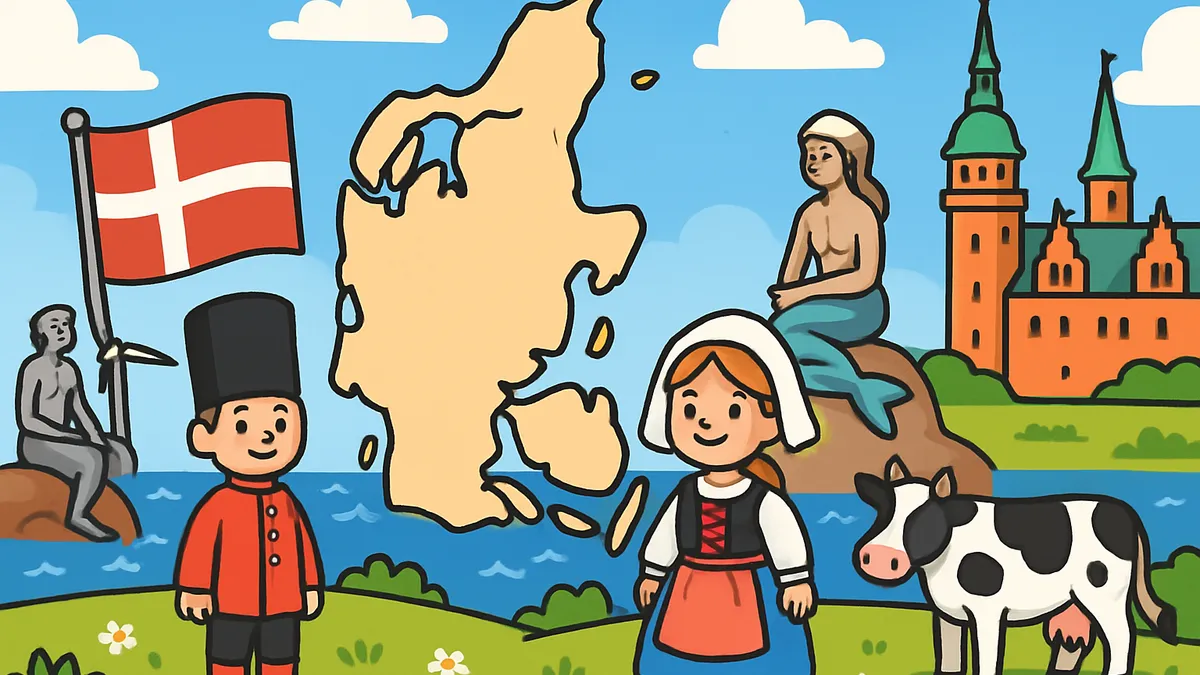
Denmark is a small but remarkably influential country in northern Europe, and the facts about Denmark reveal a nation that punches well above its size in culture, design, and quality of life. It occupies the Jutland peninsula and more than 400 islands stretching between the North Sea and the Baltic Sea. Known for its flat green landscapes, Viking heritage, and a capital city consistently ranked among the world’s most liveable, Denmark has shaped global culture in ways far beyond what its modest geography might suggest. It is one of the founding members of NATO and the United Nations, and despite being part of the European Union, has chosen to keep its own currency.
Quick Facts about Denmark
- Capital city: Copenhagen
- Population (approx.): 5.9 million (2024)
- Area (km²): 43,094
- Currency: Danish krone (DKK)
- Official language(s): Danish
- National Day: 5 June (Constitution Day / Grundlovsdag)
Geography and Landscape
Denmark consists of the Jutland peninsula, which extends northward from Germany, and an archipelago of 443 named islands, of which around 70 are permanently inhabited. The largest islands are Zealand, home to the capital Copenhagen, and Funen, which lies between Jutland and Zealand. The country is bordered by Germany to the south — its only land border — and is otherwise surrounded by the North Sea to the west and the Kattegat and Baltic Sea to the east.
The landscape is strikingly flat. Denmark’s highest natural point is Møllehøj, standing at just 170.86 metres above sea level — one of the lowest national high points in Europe. The terrain is shaped by glacial activity from the last ice age, which left behind rolling hills in central Jutland, fertile plains across most of the country, and a coastline of roughly 7,300 kilometres dotted with beaches, fjords, and dunes. The Wadden Sea along the southwestern coast is a UNESCO World Heritage Site and one of the most important tidal wetlands in the world.
Denmark also has two autonomous territories: Greenland, the world’s largest island, and the Faroe Islands in the North Atlantic. Both have home-rule governments but maintain close ties with Copenhagen.
Population and Culture
Denmark has a population of about 5.9 million people. The vast majority are ethnic Danes, with communities of German, Greenlandic, Faroese, Turkish, and other origins. Danish, a North Germanic language closely related to Swedish and Norwegian, is the official language, and English is widely spoken across all age groups.
The country is predominantly secular in practice, though the Church of Denmark, a Lutheran church, remains the official state church. Danish culture is shaped by a strong emphasis on equality, community, and what Danes call hygge — a word describing a feeling of cosiness, togetherness, and well-being that has no direct English translation. It permeates everything from home interiors to workplace culture and is often cited as a reason Denmark regularly tops global happiness indices.
Denmark has a rich design tradition, with international brands such as Bang and Olufsen and LEGO originating here. Copenhagen is one of the most bicycle-friendly cities in the world, with more bikes than cars. Danish architecture and furniture design, from Arne Jacobsen chairs to the Copenhagen Opera House, have shaped global tastes for decades.
3 Interesting Facts about Denmark
-
LEGO was invented in Denmark. Ole Kirk Christiansen founded the company in the small town of Billund in 1932. The name LEGO comes from the Danish words leg godt, meaning “play well.” Today, Billund is home to the original Legoland park and is Denmark’s second busiest airport by international visitors.
-
Denmark has one of the flattest terrains of any country in Europe. With a highest point of just 170.86 metres, the landscape is shaped almost entirely by ancient glaciers rather than tectonic activity — a stark contrast to its Scandinavian neighbours Norway and Sweden, which feature dramatic fjords and mountain ranges.
-
Hamlet’s castle is a real place in Denmark. Kronborg Castle in the town of Helsingør was the inspiration for Shakespeare’s Hamlet. Built in the late fifteenth century to control the narrow strait between Denmark and Sweden, it is now a UNESCO World Heritage Site and one of the most visited castles in northern Europe.
Where is Denmark Located?
Denmark is located in northern Europe, at the northern tip of the European continent. It occupies the Jutland peninsula, which juts northward from Germany, and a collection of islands to the east and north, including Zealand, Funen, and Bornholm. Geographically, Denmark sits between roughly 54 degrees N and 58 degrees N latitude and 8 degrees E to 15 degrees E longitude.
It shares its only land border with Germany to the south, and is otherwise flanked by the North Sea to the west and the Kattegat and Baltic Sea to the east. Across the narrow Oresund strait lies Sweden, with which Denmark is connected by the Oresund Bridge, one of the longest combined road and rail bridges in Europe. This position made Denmark historically a gateway between continental Europe and Scandinavia, and a powerful maritime nation during the Viking Age and the medieval period.
Discover More About European Countries
If you enjoy learning about Europe’s countries, our book series is designed for students, teachers, and curious readers who want a complete picture in one place. Each volume covers every country in Europe with clear facts, maps, and interesting details.
The European Countries Book – Extended Color Edition
https://www.amazon.com/dp/B0G33G45CJ
The European Countries Book – Color Edition
https://www.amazon.com/dp/B0FX9C7TS5
The European Countries Book – Black & White Edition
https://www.amazon.com/dp/B0FDRXJX7C
The European Countries Book – Color Quiz Edition
https://www.amazon.com/dp/B0HKMZJXPB
The European Countries Book – Black & White Quiz Edition
https://www.amazon.com/dp/B0HKLBS4SP