
Facts about Czech Republic: Geography, Capital and Key Information
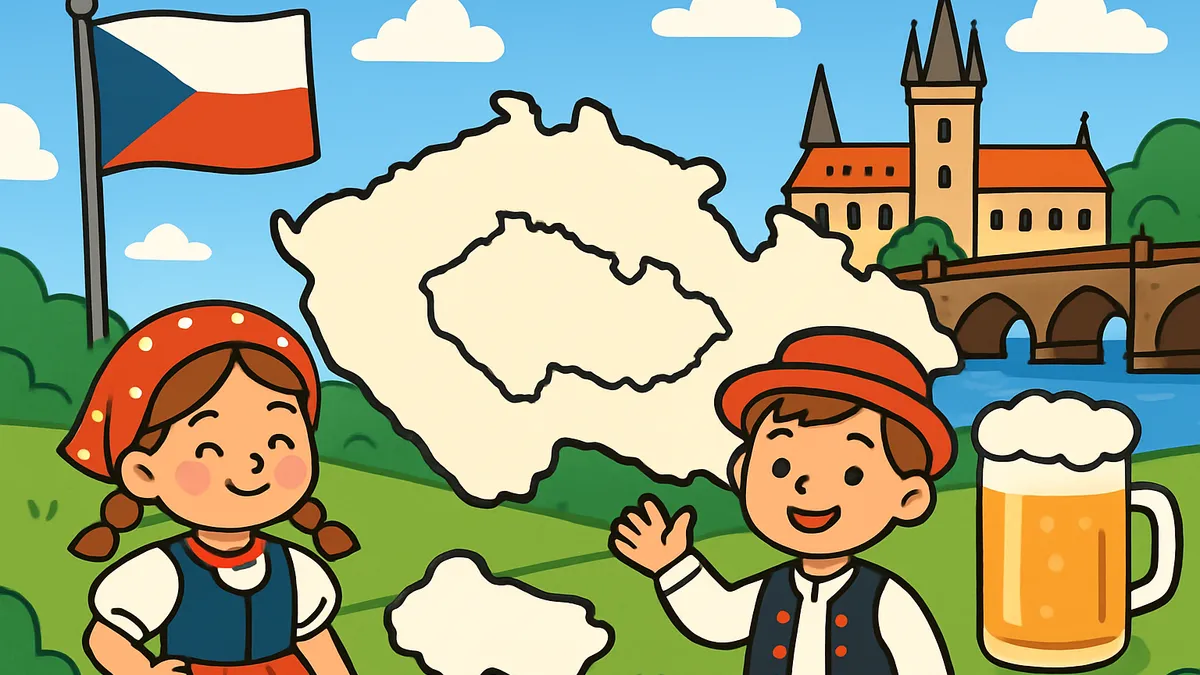
Facts about Czech Republic reveal a country rich in history, culture, and natural beauty nestled in the very heart of Europe. This landlocked nation has been a crossroads of civilisations for thousands of years, shaping a unique identity that blends Central European traditions with a proud Slavic heritage. From the fairy-tale spires of Prague to the rolling hills of Moravia, the Czech Republic offers an extraordinary depth of character for curious minds. Whether you are a student working on a school project or simply someone who loves learning about the world, exploring facts about Czech Republic is a wonderful journey through one of Europe’s most captivating countries.
Quick Facts about Czech Republic
- Capital city: Prague (Praha)
- Population (approx.): 10.9 million (2024)
- Area (km²): 78,866 km²
- Currency: Czech Koruna (CZK)
- Official language(s): Czech
- National Day: October 28 (Independence Day)
Geography and Landscape
The Czech Republic is a landlocked country located in Central Europe, bordered by Germany to the west and northwest, Austria to the south, Slovakia to the east, and Poland to the north and northeast. Its position at the geographical centre of the continent has made it historically significant as a meeting point between Western, Eastern, and Southern European cultures.
The country is composed of three historical regions: Bohemia in the west, Moravia in the east, and a small part of Silesia in the northeast. Bohemia is largely defined by a ring of mountain ranges and a wide fertile basin drained by the Vltava and Elbe rivers. The Sudeten Mountains and the Bohemian Forest line the country’s northern and western borders, providing dramatic scenery and popular hiking destinations.
The Moravian region to the east is characterised by gentle rolling hills, fertile plains, and the famous Moravian wine country, where vineyards produce some of the finest wines in Central Europe. The landscape transitions seamlessly from forests and meadows to river valleys and limestone plateaus dotted with caves.
The highest point in the country is Sněžka, rising to 1,603 metres in the Krkonoše (Giant Mountains) along the northern border with Poland. The Czech Republic’s rivers — especially the Vltava, Morava, and Odra — are important for both ecology and the country’s cultural identity, with Prague itself built along the banks of the Vltava.
Population and Culture
The Czech Republic is home to approximately 10.9 million people, the vast majority of whom are ethnic Czechs. Prague, the capital and largest city, is home to around 1.4 million residents and serves as the country’s political, economic, and cultural centre. Other major cities include Brno (the capital of Moravia), Ostrava, Plzeň, and Olomouc.
Czech culture is deeply rooted in Central European traditions, with strong influences from its Habsburg past, the Hussite religious movement, and 20th-century experiences under both Nazi occupation and communist rule. Literature, music, and visual arts have long been cherished, with composers such as Antonín Dvořák and Bedřich Smetana bringing Czech music to world stages, and writers like Franz Kafka and Milan Kundera shaping modern European literature.
Beer is an integral part of Czech culture — the country holds the highest per capita beer consumption in the world, and the city of Plzeň gave its name to the famous Pilsner style of lager. Bohemian crystal glassware, traditional puppetry, and intricate folk costumes are also celebrated parts of the national heritage.
The Czech education system is strong, with a high literacy rate and several world-class universities, including Charles University in Prague, founded in 1348 and one of the oldest in Europe.
3 Interesting Facts about Czech Republic
-
Prague Castle is the largest ancient castle in the world. Spanning over 70,000 square metres, Prague Castle has served as the seat of Czech rulers for over a thousand years and is a UNESCO World Heritage Site along with the historic city centre it overlooks.
-
Czech Republic has the highest beer consumption per person in the world. Czechs drink an average of around 130 litres of beer per person per year — a tradition rooted in centuries of brewing culture. The country is also the birthplace of Pilsner lager, invented in Plzeň in 1842.
-
Contact lenses were invented by a Czech scientist. Otto Wichterle, a Czech chemist, invented the modern soft contact lens in 1959, transforming vision care for millions of people around the world.
Where is Czech Republic Located?
The Czech Republic is located in the heart of Central Europe, surrounded entirely by land. It shares its western and northwestern border with Germany, its southern border with Austria, its eastern border with Slovakia, and its northern and northeastern border with Poland. The country lies roughly between latitudes 48° and 51° N and longitudes 12° and 19° E.
Prague, the capital, is situated at almost exactly the geographical centre of Europe, which has made it one of the continent’s great historic cities. The Czech Republic became a member of the European Union in 2004 and is also a member of NATO, aligning firmly with the community of Western democratic nations.
Discover More About European Countries
The European Countries Book – Extended Color Edition
https://www.amazon.com/dp/B0G33G45CJ
The European Countries Book – Color Edition
https://www.amazon.com/dp/B0FX9C7TS5
The European Countries Book – Black & White Edition
https://www.amazon.com/dp/B0FDRXJX7C
The European Countries Book – Color Quiz Edition
https://www.amazon.com/dp/B0HKMZJXPB
The European Countries Book – Black & White Quiz Edition
https://www.amazon.com/dp/B0HKLBS4SP