
Facts about Greece: Geography, Capital and Key Information
Introduction
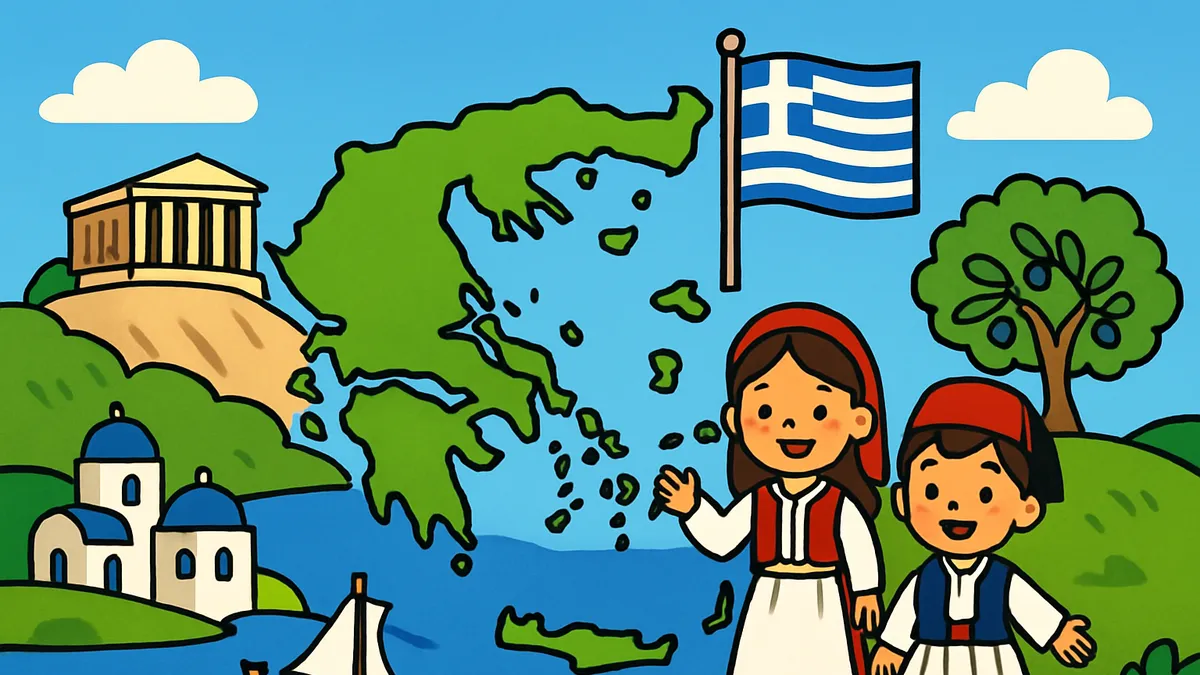
Greece is one of the most recognizable countries in Europe, known around the world for its ancient ruins, sunlit islands and deep blue seas. Facts about Greece reveal a nation where thousands of years of history sit alongside olive groves, rugged mountains and quiet fishing villages. Located at the southern edge of the Balkan Peninsula, Greece is a country of coastlines, with more islands than almost anywhere else on Earth. Many of the ideas that shaped the modern world, from democracy to theatre to the Olympic Games, began here. This article explores the geography, population and culture that make Greece such a rewarding country to learn about, whether you are a student, teacher or simply a curious reader.
Quick Facts about Greece
- Capital city: Athens
- Population (approx.): 10.4 million
- Area (km²): 131,957
- Currency: Euro (EUR)
- Official language(s): Greek
- National Day: March 25 (Independence Day)
Geography and Landscape
Greece is a strikingly mountainous country. Roughly four-fifths of its land is hills or mountains, and the Pindus range runs like a spine down the mainland, splitting the country into separate valleys and regions that stayed distinct from one another for centuries. The highest point is Mount Olympus, rising to 2,917 meters in the north, long described in ancient Greek mythology as the home of the gods. Between the ranges lie fertile plains such as Thessaly and Macedonia, where wheat, cotton and tobacco are grown.
What defines Greece most, however, is the sea. The country has around 13,600 kilometers of coastline, one of the longest of any nation in the world, and no part of the Greek mainland lies especially far from salt water. Greece includes roughly 6,000 islands and islets, though only about 227 of them are inhabited. These are gathered into well-known groups: the Cyclades in the central Aegean, famous for white-washed villages and blue-domed churches; the Dodecanese near the Turkish coast; the Ionian Islands in the west; and Crete in the south, the largest Greek island and a place with its own distinct traditions and dialect.
The climate is Mediterranean across most of the country, meaning hot, dry summers and mild, wetter winters. The mountainous north and the interior highlands are cooler, and snow is common enough in winter that Greece has several ski resorts, a fact that surprises many visitors who picture only beaches.
Population and Culture
Greece is home to around 10.4 million people, and the population is heavily concentrated in a few urban centers. Athens, the capital, holds roughly a third of the country’s residents within its greater metropolitan area, making it by far the dominant city. Thessaloniki in the north is the second largest and serves as the main port and cultural hub of northern Greece, while cities such as Patras, Heraklion on Crete and Larissa anchor their own regions.
Greek culture rests on an unusually long continuous foundation. The Greek language has been written for more than 3,400 years, making it one of the oldest recorded languages still spoken today, and modern Greek still carries words and roots that would be recognizable to a reader of ancient texts. The Greek Orthodox Church shapes much of the yearly calendar, with Easter standing as the most important celebration of the year, marked by church services, family gatherings and traditional roast lamb.
Food is central to daily life. Greek cooking leans on olive oil, fresh vegetables, herbs, fish, lamb and cheeses such as feta, in dishes including moussaka, souvlaki, spanakopita and Greek salad. Meals are typically shared slowly and socially. Music and dance also remain living traditions rather than performances for visitors, with regional dances varying noticeably between the islands, the mainland and Crete. Tourism is a major part of the economy, alongside shipping, in which Greece operates one of the largest merchant fleets in the world.
3 Interesting Facts about Greece
- The Olympic Games began in Greece, held at Olympia from 776 BC in honor of the god Zeus. The first modern Olympic Games were also hosted in Greece, in Athens in 1896, and the Olympic flame is still lit at Olympia before every Games.
- Greece has around 6,000 islands and islets, but only roughly 227 of them have people living on them. Some of the inhabited islands are home to just a few dozen residents.
- The Parthenon in Athens, completed in 432 BC, was built with almost no perfectly straight lines. Its columns lean very slightly inward and swell in the middle, an intentional design that corrects for how the human eye sees a large building and makes it appear flawlessly straight.
Where is Greece Located?
Greece sits in southeastern Europe, at the southern tip of the Balkan Peninsula, where the continent meets the Mediterranean Sea. It shares land borders with Albania to the northwest, North Macedonia and Bulgaria to the north, and Turkey to the northeast. The Aegean Sea lies to the east of the mainland and is scattered with Greek islands, while the Ionian Sea lies to the west, separating Greece from the heel of Italy. To the south, open Mediterranean water stretches toward Crete and beyond it toward North Africa.
This position has shaped Greek history for millennia. Standing between Europe, Asia and Africa, Greece has been a meeting point for trade, ideas and empires, and its harbors have connected the country outward to the wider world for as long as ships have sailed the Mediterranean.
Discover More About European Countries
If learning facts about Greece made you curious about the rest of the continent, there are more ways to keep exploring Europe’s countries, capitals and cultures with the whole family.
The European Countries Book – Extended Color Edition
https://www.amazon.com/dp/B0G33G45CJ
The European Countries Book – Color Edition
https://www.amazon.com/dp/B0FX9C7TS5
The European Countries Book – Black & White Edition
https://www.amazon.com/dp/B0FDRXJX7C
The European Countries Book – Color Quiz Edition
https://www.amazon.com/dp/B0HKMZJXPB
The European Countries Book – Black & White Quiz Edition
https://www.amazon.com/dp/B0HKLBS4SP