Facts about Ireland: Geography, Capital and Key Information
Introduction
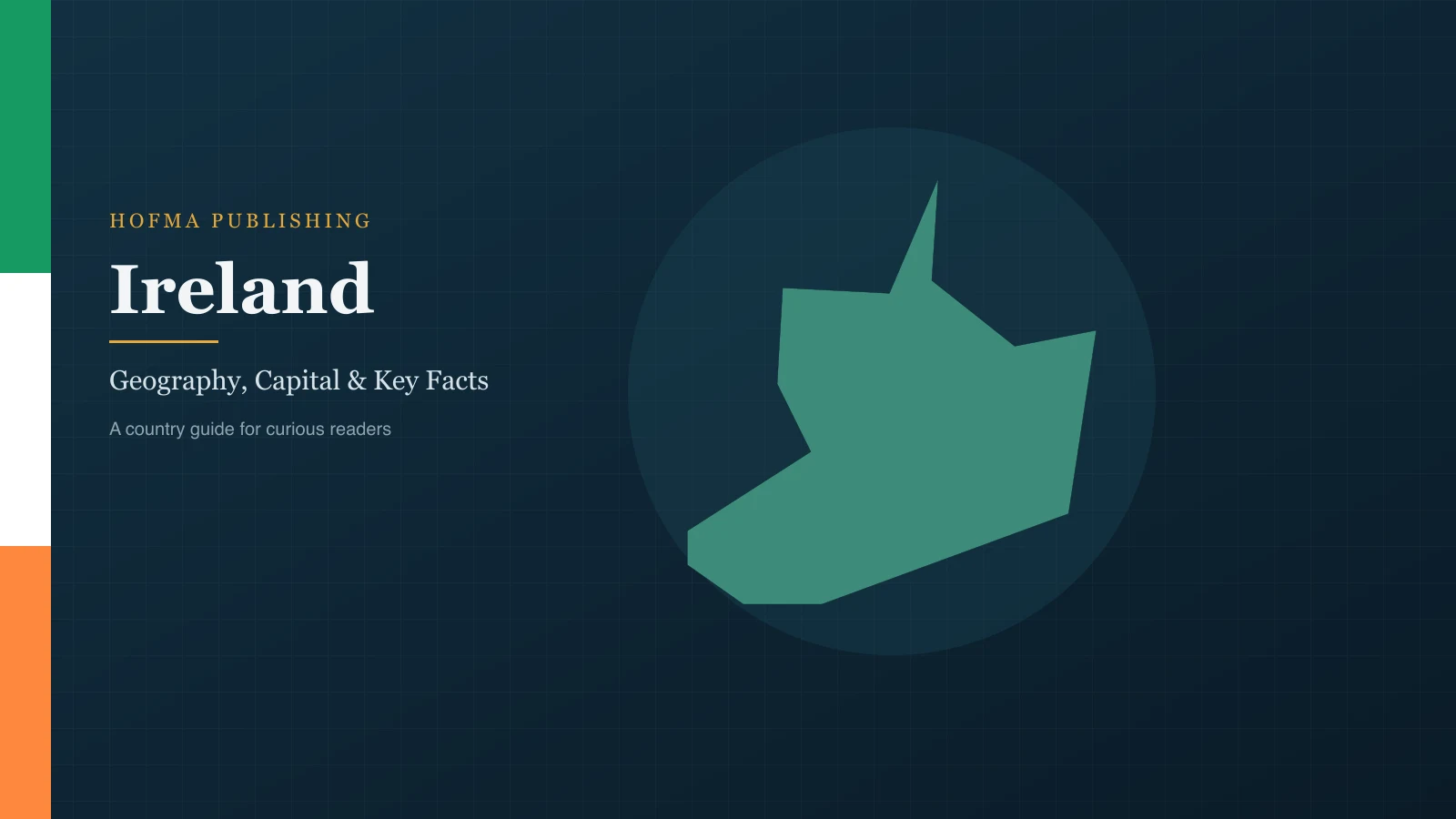
Ireland is an island country on the western edge of Europe, famous for its green fields, rugged sea cliffs and lively traditions of music and storytelling. Facts about Ireland reveal a land shaped by ice, rain and the Atlantic Ocean, where ancient stone monuments stand older than the pyramids of Egypt. The country shares its island with Northern Ireland, which is part of the United Kingdom, and it has two official languages. This article explores the geography, population and culture that make Ireland such a fascinating country for students, teachers and curious readers.
Quick Facts about Ireland
- Capital city: Dublin
- Population (approx.): 5.4 million
- Area (km²): 70,000
- Currency: Euro (EUR)
- Official language(s): Irish and English
- National Day: March 17 (Saint Patrick’s Day)
Geography and Landscape
Ireland covers most of the island of Ireland, the second-largest island in the British Isles. The country is often described as shaped like a saucer: a broad, low-lying central plain of farmland, bogs and lakes surrounded by a ring of coastal mountains and hills. Because the land is mostly low, rivers move slowly and many areas are wet and marshy.
The highest mountain is Carrauntoohil in County Kerry, which rises to about 1,039 meters in the MacGillycuddy’s Reeks range. The River Shannon is the longest river in Ireland and Britain, flowing around 360 kilometers from the north-west down to the Atlantic. Along its way it widens into large lakes such as Lough Ree and Lough Derg. Lough Corrib in the west is the largest lake in the country.
The Atlantic coastline is wild and dramatic. The Cliffs of Moher in County Clare rise more than 200 meters straight out of the sea, and the Wild Atlantic Way is a long coastal route that follows bays, peninsulas and beaches. Nearby lies the Burren, an unusual landscape of bare grey limestone where Arctic and Mediterranean flowers grow side by side in the cracks of the rock.
Ireland has a mild, damp climate thanks to the warm North Atlantic Current and the westerly winds. Winters are rarely very cold, summers are rarely very hot, and rain falls throughout the year. This steady rainfall keeps the grass growing almost all year round, which is why Ireland is often called the Emerald Isle.
Population and Culture
Around 5.4 million people live in Ireland. About a third of them live in and around Dublin, the capital and largest city, which lies on the east coast where the River Liffey meets the Irish Sea. Other important cities include Cork in the south, Limerick and Galway in the west, and Waterford in the south-east.
Irish, also called Irish Gaelic, is the first official language and is taught in every school, while English is the language most people use every day. In the Gaeltacht areas, found mainly along the west coast, Irish is still spoken as a community language. Road signs across the country show place names in both languages.
Music, dance and storytelling are at the heart of Irish culture. Traditional music is played on instruments such as the fiddle, the tin whistle and the bodhrán drum, and Irish dancing is known around the world. Ireland has also produced many famous writers and poets. Sport is a big part of daily life, especially the Gaelic games of hurling and Gaelic football, which are amateur sports played by local clubs in every county. The harp is the national symbol of Ireland and appears on its euro coins.
3 Interesting Facts about Ireland
- Newgrange, a huge stone passage tomb in County Meath, was built around 3200 BC, which makes it older than both Stonehenge and the Great Pyramid of Giza. Once a year, at sunrise around the winter solstice, a beam of sunlight shines down its long passage and lights up the inner chamber.
- Halloween has its roots in Samhain, an ancient Celtic festival that marked the end of the harvest and the start of winter. Irish people who moved abroad helped spread the tradition to other parts of the world.
- Skellig Michael, a steep rocky island off the coast of County Kerry, holds the remains of a monastery built by early Christian monks more than a thousand years ago. Today it is a UNESCO World Heritage Site and a home for thousands of nesting seabirds, including puffins.
Where is Ireland Located?
Ireland is located in north-western Europe and is part of the British Isles. Its only land border is with Northern Ireland, which lies in the north-east of the island and is part of the United Kingdom. To the east, the Irish Sea separates Ireland from Great Britain, with Wales directly across the water. The narrow North Channel lies between the north-east of the island and Scotland.
To the west and south, Ireland faces the open Atlantic Ocean, and the Celtic Sea lies off its southern coast. France is the closest country on the European mainland, across the sea to the south-east. Ireland is a member of the European Union and uses the euro, which links it closely to the rest of the continent.
Discover More About European Countries
If learning facts about Ireland has sparked your curiosity, there is a whole continent of countries, capitals and cultures waiting to be explored. These books are made for children, families and classrooms who want to discover more together.
The European Countries Book – Extended Color Edition
https://www.amazon.com/dp/B0G33G45CJ
The European Countries Book – Color Edition
https://www.amazon.com/dp/B0FX9C7TS5
The European Countries Book – Black & White Edition
https://www.amazon.com/dp/B0FDRXJX7C
The European Countries Book – Color Quiz Edition
https://www.amazon.com/dp/B0HKMZJXPB
The European Countries Book – Black & White Quiz Edition
https://www.amazon.com/dp/B0HKLBS4SP