
Facts about Italy: Geography, Capital and Key Information
Introduction
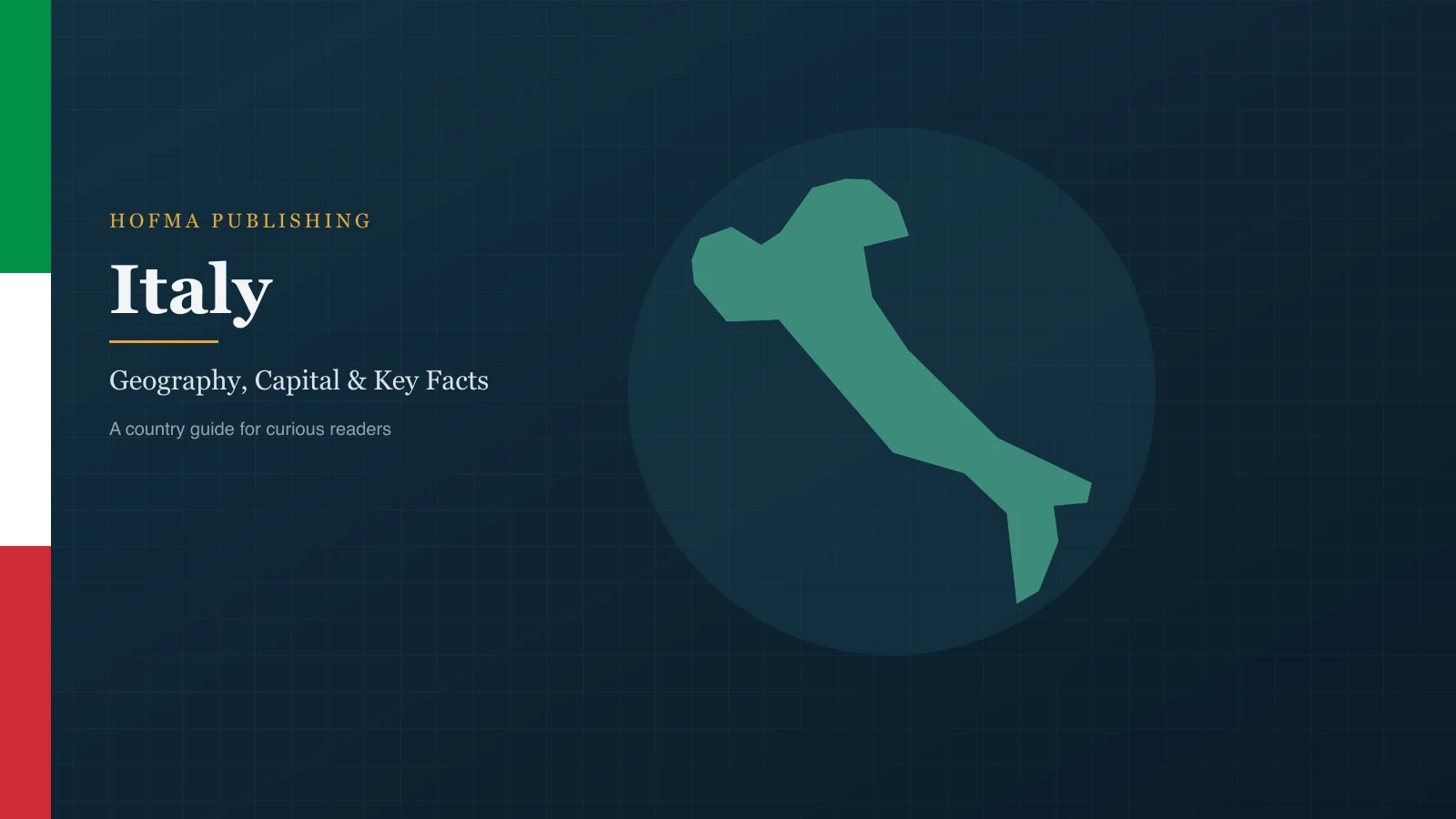
Italy is a country in southern Europe, instantly recognisable on any map by its long boot-shaped peninsula reaching into the Mediterranean Sea. Facts about Italy take us from snowy Alpine peaks to smoking volcanoes, from ancient Roman ruins to canal cities built on water. For centuries the land was home to the Roman Empire and later to the artists of the Renaissance, and their legacy still shapes the country today. This article explores the geography, population and culture of Italy for students, teachers and curious readers.
Quick Facts about Italy
- Capital city: Rome
- Population (approx.): 59 million
- Area (km²): 302,000
- Currency: Euro (EUR)
- Official language(s): Italian
- National Day: June 2 (Republic Day)
Geography and Landscape
Italy is made up of a long peninsula, two large islands, Sicily and Sardinia, and many smaller islands. The peninsula stretches roughly 1,000 kilometers from the Alps in the north to the Strait of Messina in the south, where only a narrow channel separates the mainland from Sicily.
Mountains cover a large part of the country. The Alps form a great curved wall along the northern border, and Mont Blanc, called Monte Bianco in Italian, rises to about 4,800 meters on the border with France. The Apennine Mountains run down the length of the peninsula like a backbone, from the north-west almost to the tip of the boot. Between the Alps and the Apennines lies the Po Valley, a wide and fertile plain that is the most important farming and industrial region of Italy.
The River Po is the longest river in the country, flowing about 650 kilometers from the Alps to the Adriatic Sea, where it forms a broad delta. In the north, glaciers carved out a string of beautiful lakes at the foot of the mountains, including Lake Garda, the largest lake in Italy, as well as Lake Maggiore and Lake Como.
Italy is also a land of volcanoes. Mount Etna in Sicily is one of the most active volcanoes in the world, Stromboli erupts in small bursts almost continuously, and Mount Vesuvius near Naples is famous for the eruption in AD 79 that buried the Roman town of Pompeii.
The coastline is long and varied, washed by four seas: the Ligurian, Tyrrhenian, Ionian and Adriatic. Most of the country enjoys a Mediterranean climate with hot, dry summers and mild, wetter winters, while the Alps and the Po Valley have colder winters with snow and fog.
Population and Culture
Around 59 million people live in Italy. Rome is the capital and largest city, followed by Milan, the country’s business and fashion centre, and Naples in the south. Other well-known cities include Turin, Florence, Venice, Bologna and Palermo. The north is more industrial and densely populated, while large parts of the south remain more rural.
Italian is the official language, and the country also has many regional dialects. In a few border areas, minority languages such as German, French and Slovene are spoken alongside Italian. Italy only became a single, unified country in 1861, and strong regional identities can still be felt in food, accents and traditions.
Few countries have influenced art and science as much as Italy. Painters and sculptors such as Leonardo da Vinci and Michelangelo worked here during the Renaissance, and Galileo Galilei made important discoveries in astronomy. Opera was born in Italy, and Italian words such as piano, allegro and soprano are still used by musicians everywhere. Italian food, from pasta and pizza to gelato, is enjoyed all over the world, and family meals remain an important part of daily life.
3 Interesting Facts about Italy
- Italy has more UNESCO World Heritage Sites than any other country in the world, including the historic centres of Rome, Florence and Venice, the ruins of Pompeii and the Leaning Tower of Pisa.
- Venice is built on more than one hundred small islands in a shallow lagoon. Instead of streets, many parts of the city are connected by canals and around 400 bridges, and boats are used for transport.
- Two independent countries lie completely inside Italy: San Marino, one of the oldest republics in the world, and Vatican City, the smallest country in the world, which sits in the middle of Rome.
Where is Italy Located?
Italy is located in southern Europe and stretches deep into the Mediterranean Sea. To the north it borders France, Switzerland, Austria and Slovenia, with the Alps forming most of this frontier. San Marino and Vatican City are surrounded entirely by Italian territory.
To the west lie the Ligurian and Tyrrhenian Seas, with the French island of Corsica just north of Sardinia. To the east, the Adriatic Sea separates Italy from the Balkan Peninsula, and to the south the island of Malta lies a short distance from Sicily, while the coast of North Africa is not far beyond. Italy is a founding member of the European Union and uses the euro.
Discover More About European Countries
If learning facts about Italy has sparked your curiosity, there is a whole continent of countries, capitals and cultures waiting to be explored. These books are made for children, families and classrooms who want to discover more together.
The European Countries Book – Extended Color Edition
https://www.amazon.com/dp/B0G33G45CJ
The European Countries Book – Color Edition
https://www.amazon.com/dp/B0FX9C7TS5
The European Countries Book – Black & White Edition
https://www.amazon.com/dp/B0FDRXJX7C
The European Countries Book – Color Quiz Edition
https://www.amazon.com/dp/B0HKMZJXPB
The European Countries Book – Black & White Quiz Edition
https://www.amazon.com/dp/B0HKLBS4SP